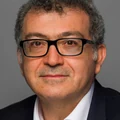
Pr Eric E. Gabison
Full professor · Ophthalmology, cornea & ocular surface
Born 13/06/1972, Fontenay-sous-Bois, France · French nationality
Fondation A. de Rothschild, 25-29 rue Manin, 75019 Paris
Current position
Full professor and hospital practitioner (PU-PH). Head of the ophthalmology department at the Adolphe de Rothschild Foundation (Paris). Director of the laboratory for translational research and experimental corneal surgery (T-REX). Head of the national referral centre for rare eye diseases. Specialised in complex corneal surgery (endothelial and lamellar keratoplasty), cataract surgery and refractive surgery.
A. de Rothschild Foundation
Université Paris Cité
T-REX laboratory
Rare diseases centre
Education & qualifications
Medical track
- 2014Full professor – hospital practitioner (PU-PH), Université Paris Cité
- 2012–2014Associate professor – hospital practitioner (MCU-PH)
- 2010European Board of Ophthalmology (EBO)
- 2008–2013University hospital practitioner (PHU), Bichat – Rothschild Foundation
- 2003–2008Clinical chief – assistant then associate, Bichat Hospital (Prof. Hoang-Xuan)
- 2003MD, Paris VII Faculty of Medicine
- 1996–2002Surgical residency, Paris
- 1996Paris hospitals residency competition, surgery (ranked 1st)
Scientific track
- 2010Accreditation to supervise research (HDR), Université Paris VII
- 2008PhD, St-Louis Hospital, Université Paris VII
- 1999–2001Cornea and Refractive Surgery Research Fellow – Massachusetts Eye and Ear Infirmary, Harvard Medical School, Boston, USA
- 1999Master’s research degree (DEA), epithelial pathology, Paris VII
- 1996Master of biological and medical sciences, Paris XII
Research
116
indexed publications
1587
SIGAPS score (team)
4
patents
Projects & clinical trials (principal investigator)
- PHRC-N (2025–2030) – Cell therapy for ocular GVHD (MINING) – PI
- PHRC-N (2025–2030) – Cell therapy for chemical burns (SYMBOL) – PI
- PEPR COBRAS (2025–2029) – biotherapy & bioproduction – PI
- Téléthon strategic programme MICELLES (2024–2027) – PI
- CASCADE (FP7) – cell therapy for ocular burns – Work Package lead
- Cohorts: dry eye (ALTESSE), keratoconus (KERMIT), genetic limbal deficiency (SILOG-PRIMA-TALEN), herpetic keratitis
Team leadership
- Since 2018 – Director of the T-REX laboratory (Rothschild Foundation)
- 2013–2020 – INSERM UMR-S 976, Skin Research Institute (St-Louis)
- 2008–2013 – Vision Institute (XV-XX) · 2005–2008 – CNRS UMR 7142
Awards
- Lally Fellowship 2000 (Harvard Medical School)
- Dalloz Prize for ophthalmology research 2011 (Institut de France)
Teaching
- Examiner, European Board of Ophthalmology (since 2008)
- Lead / lecturer for several university diplomas: burns medicine, cell therapy, ocular surface, ocular inflammation & infection, ophthalmic drugs
- Undergraduate and ophthalmology residents teaching, Université Paris VII / Paris Cité
- Master’s “Epithelial pathology” – cornea module
Clinical & surgical activity
- Specialist clinics: corneal grafts (follow-up, rejection, astigmatism), inflammatory disease (scleritis, uveitis), infections (keratitis, endophthalmitis), wound-healing disorders, burns, dystrophies, keratoconus, rare genetic diseases (ligneous conjunctivitis, aniridia)
- Anterior segment surgery: corneal grafts (DALK, DMEK, DSAEK, penetrating), cataract, reconstruction (amniotic membrane, limbus), refractive surgery (LASIK, PRK, PTK)
Responsibilities & expertise
- Editorial board, “The Ocular Surface” · Scientific board, TFOS (Tear Film & Ocular Surface Society)
- Biovigilance correspondent (Rothschild Foundation) · Board, French Eye Bank
- Expert reviewer: ANSM, AP-HP, ANR, Fondation de l’Avenir
International collaborations
Harvard / Schepens Eye Research Institute (Boston)
Jules Gonin Hospital, Lausanne
Hadassah Hospital, Jerusalem
Rabat University Hospital
Bangkok University
Publications
116 publications in indexed journals, 14 as first author and 34 as senior author. See the complete list and the papers explained →
Book chapters
- Gabison EE. Corneal wound-healing agents. In: Médicaments et biothérapies en ophtalmologie — French Society of Ophthalmology 2023 Report, chapter 21. Elsevier Masson. Full text, open access